The three Layers: Core, Engine, and Reserve, and the job each one does
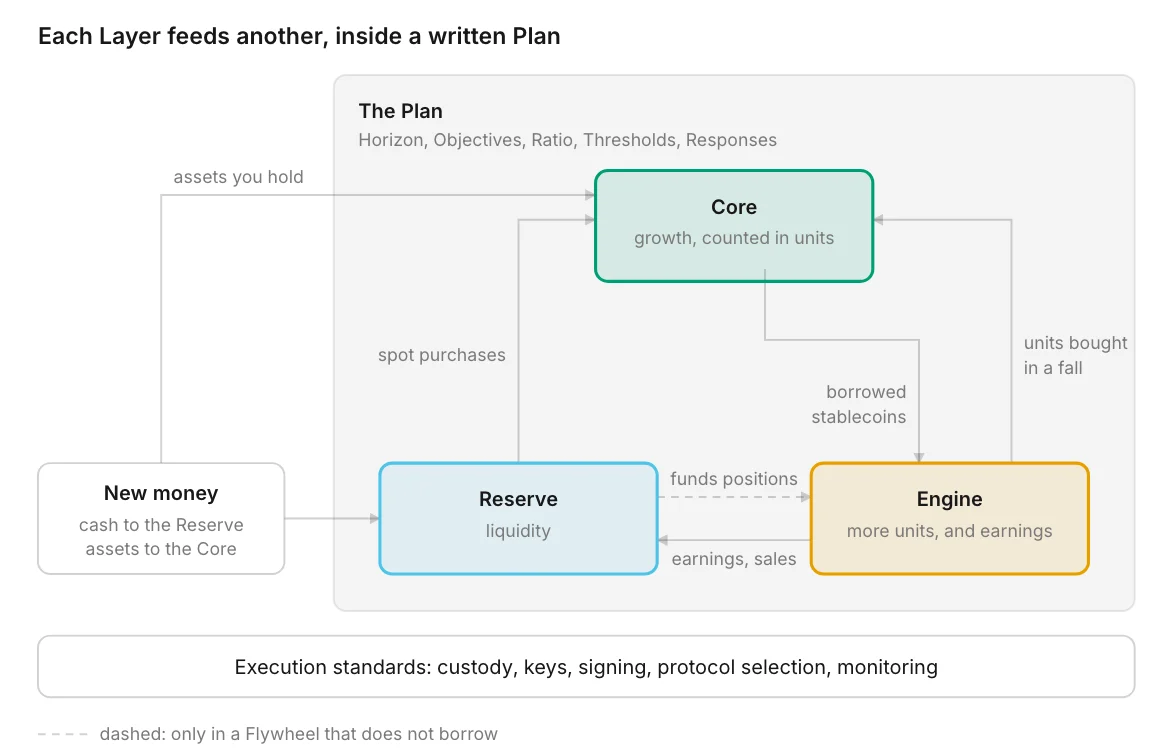
The Crypto Flywheel™ model has three Layers. The Core holds long-term assets, the Engine accumulates as prices fall and sells as they rise, and the Reserve keeps stable assets available.
Based on the paper “The Crypto Flywheel Whitepaper, version 1.0” (Luminary One, ).
The Crypto Flywheel™ model has three Layers, and each one has a different job. The Core holds assets chosen for long-term ownership, the Engine accumulates units as prices fall and sells inventory as prices rise, and the Reserve keeps stable assets available. A written Plan connects them and sets limits on the risks they create.
The Core
The Core holds long-term units and, in a Flywheel that borrows, provides collateral for the loan. It is measured in units as well as dollars. If BTC doubles in price, the dollar value of a fixed BTC holding doubles, but the number of BTC stays the same.
Long-term Core units are held for the Plan's Horizon rather than sold to rebalance the portfolio. Assets used as collateral must be accepted by the lending market. At the end of the Horizon, the Plan determines whether the Core is sold or held for another period.
Ownership alone generates no income, so the Core relies on the other two Layers for that job.
The Engine
The Engine uses liquidity positions to accumulate units and earn trading fees. It is normally funded by borrowing against the Core, although it can operate without a loan. The whitepaper's examples use concentrated liquidity positions (CLPs), which buy and sell as the price moves through a selected range.
A CLP trades according to price movements, regardless of what the investor intends. Each position therefore has a defined Role, set by where its range sits against the current price:
| Role | Where the range sits | What the position does |
|---|---|---|
| Accumulation | Below the price | Holds stablecoins and buys as the price falls |
| Growth | Around the price | Buys and sells in either direction |
| Distribution | Above the price | Holds units and sells as the price rises |
The Plan sets a rule for each position before it opens. If liquidity is left in place after an Accumulation position fills, a recovery through the same range sells the units back into stablecoins. A CLP earns fees only when swaps pass through its active liquidity.
The Reserve
The Reserve holds stable assets that the Plan can access when needed. Its main job is to fund purchases during a decline. It also has two supporting roles: covering interest when earnings are insufficient and, in a Flywheel that borrows, repaying debt when an extreme decline threatens the loan.
The Plan sets the Reserve's target size and the price declines at which it buys in stages. The Plan also limits positions with redemption delays or withdrawal queues, because the right to withdraw is of little use if the market cannot meet it. The Reserve may earn income, but its primary purposes are liquidity and resilience.
How the Layers feed one another
New cash enters through the Reserve, and digital assets already owned enter the Core. In a Flywheel that borrows, a loan against the Core funds the Engine. During a deep decline, the Reserve also buys units for the Core.
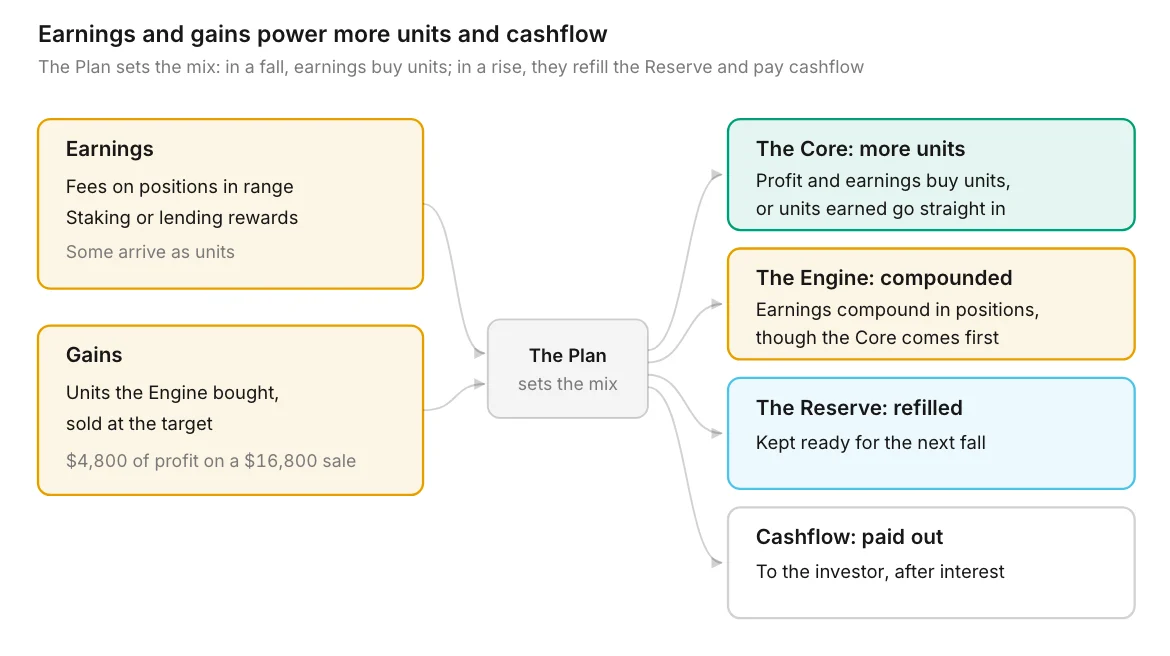
The Plan determines whether earnings and sales proceeds buy more units, fund the Engine, refill the Reserve, or are paid out as cashflow. Without these flows, the portfolio would be separate positions rather than an integrated Flywheel.
The two live Flywheels show the Layers in a real portfolio.
What can go wrong
Questions
Is the Reserve the same as the Engine's stablecoins?
No. The Reserve holds the investor's own stable capital. In a Flywheel that borrows, the Engine's stablecoins come from the loan and sit outside the Ratio.
Do units the Engine accumulates join the Core?
They can strengthen collateral during a recovery, but they typically remain designated for sale at the Plan's target. Long-term Core units are held for the Horizon.
Is Turbo a fourth Layer?
No. Turbo is an optional, limited allocation to riskier digital assets, and it sits outside the three Layers.